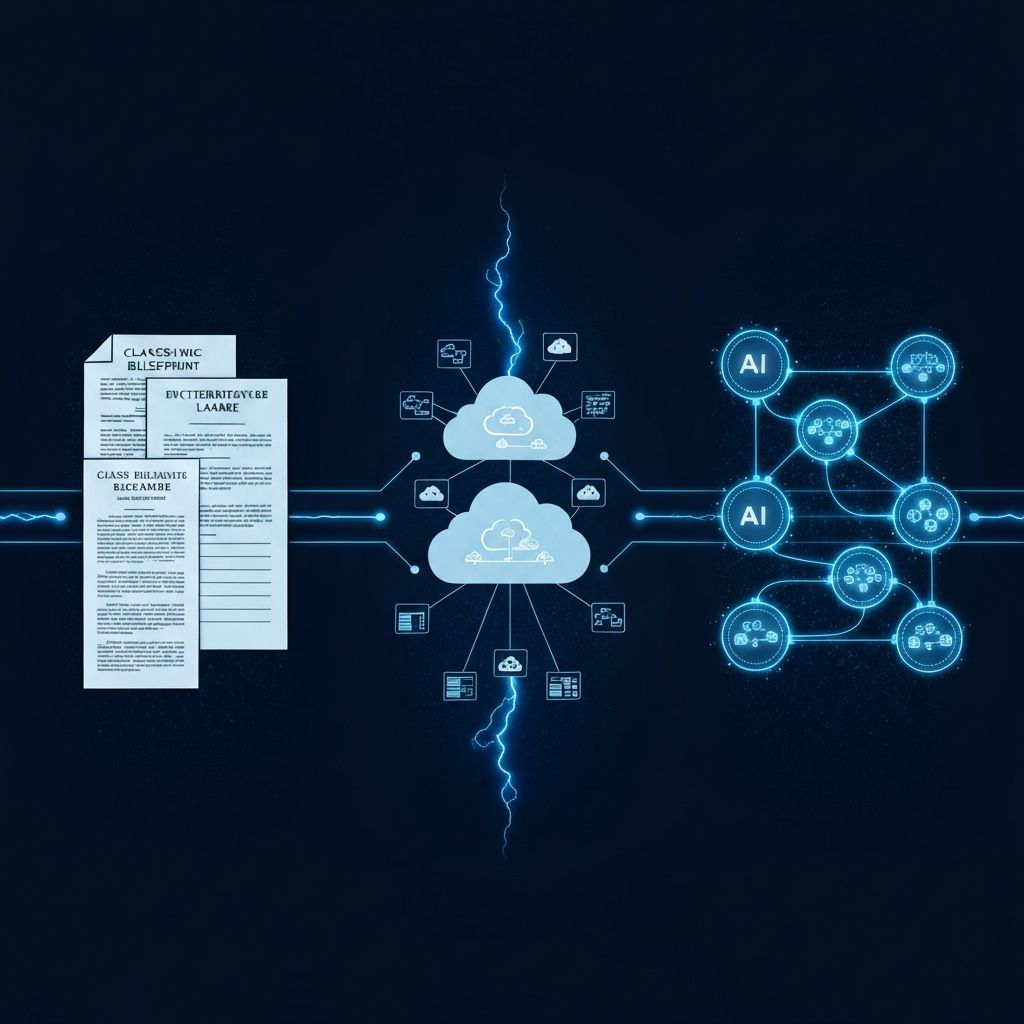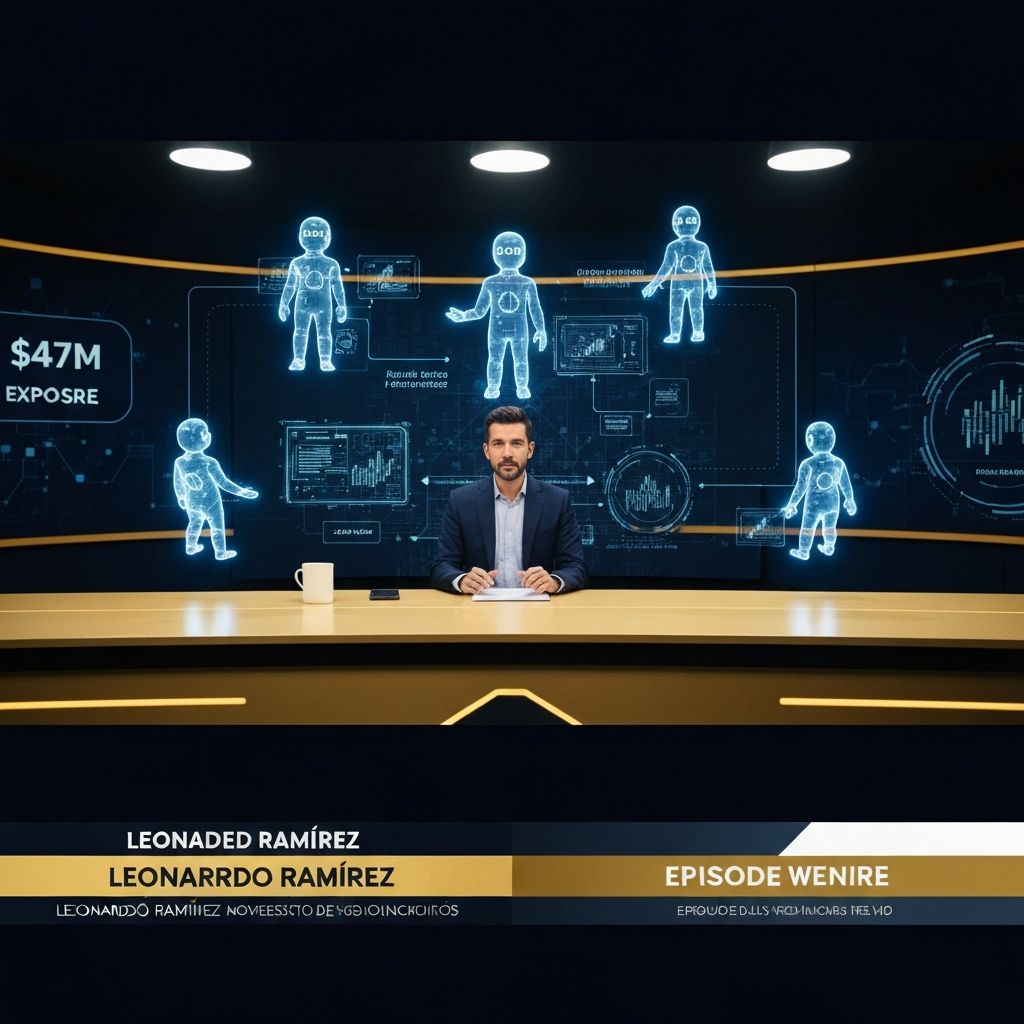
On Tuesday, April 22, at precisely 11:00 AM Eastern, something unprecedented happened in enterprise AI governance. Not in a Big 4 consulting boardroom. Not in a regulatory roundtable. In a live webinar room, in front of 50 executives, an enterprise architect named Leonardo Ramírez opened ten Claude agents and began building — in public — the governance framework that a trillion-dollar industry has been told would take 18 months and nearly three million dollars to produce.
By 12:30 PM, he had done more than prove a point. He had created a problem for every consulting firm that has ever quoted a governance engagement by the quarter.
By Thursday, April 24 — Episode 2 — the problem had deepened considerably.
The Challenge That Started Everything
The Trillion-Dollar Governance Gauntlet™ was born from a private conversation. A major industry player presented Ramírez with a challenge: build a governance framework for AI agent deployment under ISO 42001, the EU AI Act, and SEC requirements in 30 days. Their consultants had quoted 18 months and $2.875 million for the engagement.
Ramírez accepted the challenge, then made a decision that will be studied in governance circles for years: he decided to do it publicly, inside a live format he calls Architects Room™ — the first reality show of the agentic economy.
"More compute doesn't solve governance. More models don't solve governance. Only a decision framework does." — Leonardo Ramírez, Founder, ARCHAI WORLD™
The structure: four live episodes, 90 minutes each, two languages. Each episode builds one or more layers of a five-layer decision architecture. Every step of construction is visible. Every agent prompt is live. Every output is unscripted.
Episode 1: "El Lunes Imposible del CEO"
The first episode, conducted in Spanish on April 22, established the proof of concept for Layer 1: the Executive Command Center. One audience member was selected at random to have their real business challenge solved live by four agents: Capability Mapper, Risk Analyzer, Decision Auditor, and Compliance Checker.
| Agent | Result | Time |
|---|---|---|
| Capability Mapper | Governance gap identified. Consultants estimated 3 weeks. | 87 sec |
| Risk Analyzer | 4 of 8 systems classified HIGH RISK with zero documentation. | ~4 min |
| Decision Auditor | 312 of 340 operations required human approval. None received it. | ~6 min |
| Compliance Checker | Loss capped at $800K with governance vs. $47M without. | ~8 min |
The $47 million exposure number traveled quickly through financial technology networks. This was not a projection �� it was a documented scenario with real parameters, producing a real output gap. For governance practitioners, the 87-second capability mapping that would cost consultants three weeks is the empirical data point that changes budget conversations.
Episode 2: "The Impossible Monday of a CTO"
Episode 2, conducted in English on April 24, advanced governance into territory most enterprises have not begun to address: what happens when the governance layer thinks strategically, not just operationally.
The case study: a $4.2 billion asset manager facing a regulatory inquiry under the EU AI Act, a board presentation due in 72 hours, a third-party API deprecation with unknown governance implications, and the immediate resignation of the organization's Head of AI Engineering — the single person holding governance knowledge for four of eight deployed AI systems.
The Strategic Intelligence Layer
The first agent demonstrated in Episode 2 did not produce a report. It produced a decision prompt: prioritized, decision-ready intelligence about what requires attention first, which authority structure is required, and the regulatory clock on each item.
Within nine minutes, the system identified a portfolio rebalancing agent making autonomous decisions on $340 million in positions — with zero audit trail — that neither the CTO nor board had visibility into. The agent had been deployed six months prior. The regulatory inquiry specifically referenced it.
"This is not negligence. This is what happens when organizations deploy AI faster than they build governance." — Leonardo Ramírez
The Workforce Transformation Layer
The second agent addressed the most misunderstood dimension of AI governance: not whether humans are involved in AI decisions, but which humans, with what authority, under which conditions.
The agent surfaced 2 critical discoveries: governance decisions requiring board-level authorization that had no documented authority structure in the organization. Those two undocumented decision structures were identified as the root cause of the $1.2 million cost of the "impossible Monday."
23 Minutes to SEC-Ready Documentation
The third agent produced three simultaneous outputs in 23 minutes: a board briefing with color-coded risk classification, a formal regulatory response framework in EU AI Act format, and an emergency knowledge transfer protocol.
What This Means for Enterprise AI Governance
The Gauntlet reveals a fundamental shift: the governance gap in enterprise AI is not primarily a technology problem. The agents deployed are Claude — available to any enterprise today. The differentiator is architecture.
Episode 3 (April 29) will address a bank operating with 47 unauthorized AI systems and $300 million in regulatory exposure. Episode 4 (May 1) will construct the complete five-layer framework live, using a $50 billion logistics company's board demand for an AI strategy in 30 days.
At Day 30, the complete Governance Gauntlet Playbook will be published open-source. Ramírez has positioned this open-source publication as the driver of institutional credibility that will fuel ARCHAI WORLD™'s closed-access enterprise engagements.
It is a significant bet. If the first two episodes are representative, it is a bet increasingly well-founded.