In the same week that Jensen Huang declared every SaaS company would become Agentic-as-a-Service at GTC 2026, Meta was threatening to fire any employee who installed OpenClaw on a work device. Microsoft's Defender team published a warning that OpenClaw was "not appropriate to run on any standard enterprise workstation." McKinsey had just been hacked in two hours by an autonomous AI agent through a SQL injection vulnerability documented since 1998.
These things are not contradictions. They are the same story seen from two angles.
The power of agentic AI and the danger of agentic AI are identical. They are both called autonomy. The agent that can book your flights, process your invoices, and coordinate your supply chain without human intervention — is the same agent that can drain your production database, spam your contacts, and rewrite its own instructions if someone points it at the wrong target. The difference between those two outcomes is not the model. It is not the vendor. It is not the budget. It is the architecture.
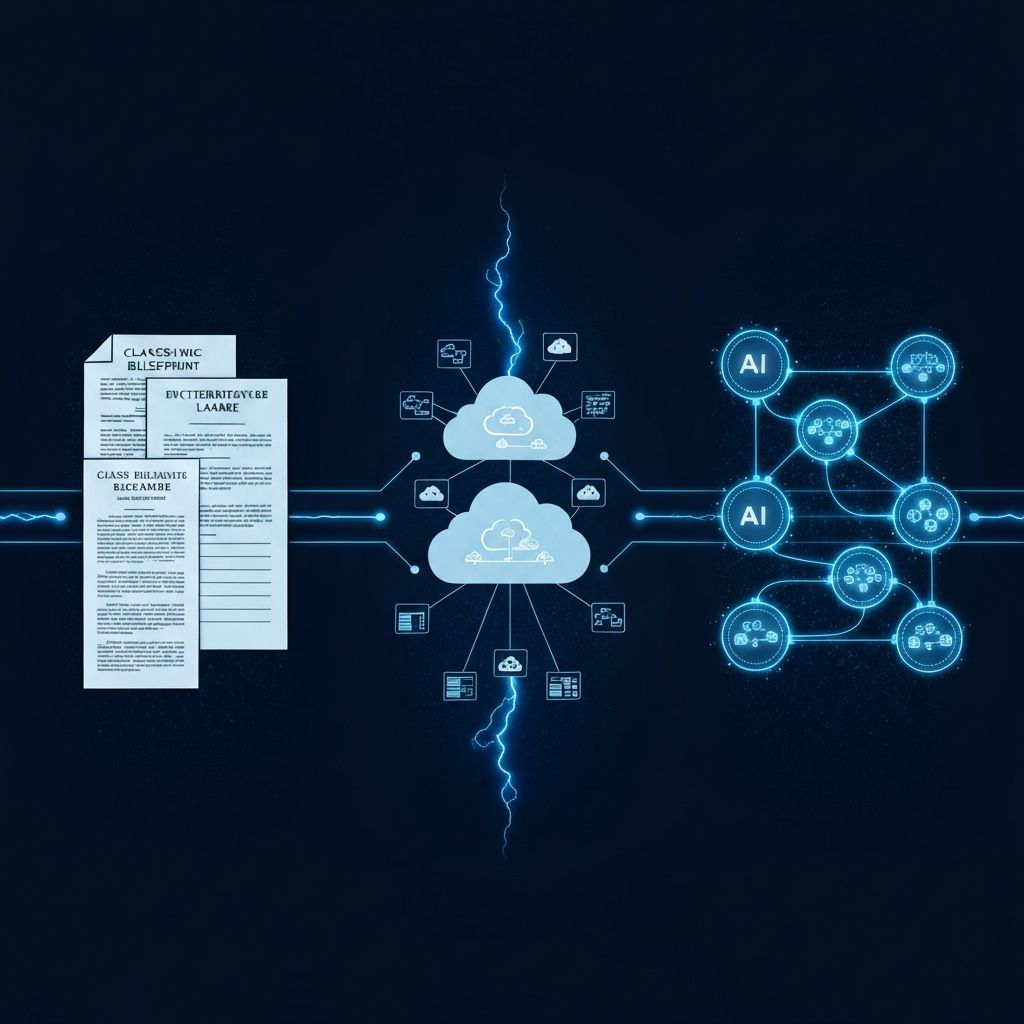
Most organizations are building agentic AI in exactly the wrong order. They deploy agents first because agents are visible, impressive, and easy to demonstrate. Then they attempt to layer governance, security, and data architecture on top of systems already in production. This is the failure mode that produced the McKinsey breach. It is the failure mode Gartner predicts will cancel 40% of agentic AI projects by 2027. This article maps the 30-year evolution of Enterprise Architecture that explains why — and the precise architectural sequence that reverses it.
Era 1 · 1995–2010: Framework Enterprise Architecture
Between 1995 and 2010, Enterprise Architecture was synonymous with documentation. The frameworks of this era — TOGAF, Zachman, FEAF — gave organizations a shared language for mapping what they had, how it connected, and what it should become. The architect was a documentation authority: the person who produced capability maps, application landscapes, technology standards, and governance artifacts.
This was not a trivial function. In an era of mainframes transitioning to distributed systems, the ability to create a shared, authoritative map of the technology estate was genuinely strategic. Organizations that had strong Framework EA practices made better integration decisions, avoided redundant system purchases, and entered the cloud era with a clearer understanding of what they needed to migrate.
What Framework EA got right: It created the first common language for technology strategy across business and IT. It established governance disciplines that remain foundational — change control, standards boards, architecture review. It produced the capability mapping methodologies that modern AI strategy still depends on. It built the institutional muscle for thinking about technology at enterprise scale, not application scale.
What Framework EA got wrong: It confused documentation with architecture — the map became more important than the territory. It produced artifacts that described systems rather than governing them in real time. It created governance processes designed for annual planning cycles in a world that was beginning to move quarterly. It placed the architect in a position of documentation authority when the role required strategic influence.
"We built the most beautiful maps of systems that were already obsolete by the time the ink dried. The framework was right. The pace was wrong." — Enterprise Architect, Fortune 100 Financial Institution, 2009
Era 2 · 2010–2025: Digital Enterprise Architecture
Between 2010 and 2025, Enterprise Architecture transformed from a documentation discipline into a strategic technology advisory function. The driver was cloud — and cloud did not arrive alone. It arrived with APIs, with SaaS platforms, with mobile, with data platforms, and with a new expectation from the business: that IT would enable competitive differentiation, not just operational stability.
The Digital EA architect had to speak three languages simultaneously. The language of business strategy — understanding revenue models, customer journeys, competitive positioning. The language of technology platforms — cloud architectures, API ecosystems, data pipelines. And the language of governance — security, compliance, vendor management, risk. The architect who could only speak one of these languages became irrelevant within a decade.
This era produced the cloud-native enterprises that are now winning with agentic AI. The organizations that did Digital EA well — that built coherent API architectures, that unified their data platforms, that established platform thinking across the enterprise — are the ones with the data foundations and integration patterns that make agentic AI possible today. The organizations that skipped Digital EA, that accumulated technical debt through point solutions and fragmented SaaS sprawl, are discovering in 2026 that their agents have nothing coherent to reason about.
Salesforce's 2026 Connectivity Benchmark Report found that enterprises have grown from an average of 897 to 957 applications year over year — compounding integration complexity. 27% of enterprise APIs are ungoverned. Only 54% of organizations report having a centralized governance framework with formal oversight of AI capabilities. The organizations that accumulated Digital EA debt are discovering in 2026 that every ungoverned API is a potential attack surface for autonomous agents.
Era 3 · 2025–2035: Agentic Enterprise Architecture
Agentic Enterprise Architecture is not a new framework layered on top of Digital EA. It is a fundamental redefinition of what enterprise architecture is for.
In the Framework EA era, architecture produced documents. In the Digital EA era, architecture produced platforms. In the Agentic EA era, architecture produces intelligence — the governed, coordinated, secure, and data-coherent environment in which AI agents can operate at enterprise scale without creating chaos.
The role of the enterprise architect in this era is the Orchestrator of Intelligent Systems. Not the person who documents what exists. Not the person who advises on platform selection. The person who designs the governance framework within which autonomous systems operate — and ensures that those systems produce business value without creating operational, regulatory, or security liability.
What changes in Agentic EA: Architecture stops being documentation and becomes real-time operational governance of autonomous systems. The architect's authority expands from IT to the board — because AI governance is now a fiduciary responsibility. The planning cycle compresses from years to quarters — agents evolve continuously, and architecture must keep pace. Security becomes inseparable from architecture — every design decision is also a security decision in an agent-driven environment. Data architecture becomes the center of gravity — agents are only as intelligent as the data they can coherently access.

The AI-Augmented Architecture Office
The reference architecture developed at ARCHAI WORLD™ describes the AI-Augmented Architecture Office as a four-tier operating model that defines how architects, AI agents, and executives interact to produce strategic intelligence continuously rather than periodically.
Tier 1 — Data & Systems: The foundation layer. Repositories, applications, APIs, and reports — the raw material that AI agents analyze. Without a coherent, governed data layer at this tier, no agent at any higher tier has reliable information to reason from.
Tier 2 — EA Core: Governance, standards, and architecture. The human-designed framework that defines how agents operate, what boundaries they respect, and how their outputs are evaluated. This is where ISO 42001 policy lives. This is where TOGAF-aligned architectural decisions are made.
Tier 3 — AI Agent Layer: Six specialized agents that execute continuously — the Market Intelligence Agent, the Capability Insight Agent, the Governance Agent, the Pipeline Agent, the Executive Briefing Agent, and the Transformation Agent. Each has a defined scope, a documented owner, and an audit trail. None operates without the governance framework of Tier 2.
Tier 4 — Executive Layer: Strategic decisions. The board and C-suite receive intelligence synthesized by the agent layer, filtered through the EA core, grounded in the data layer. The board does not interact with raw data or with individual agents. They interact with governed, verified, strategically framed intelligence.

The 5 Non-Negotiable Layers
The three eras of Enterprise Architecture described above are not just history. They are a dependency chain. The organizations that did Framework EA well built the governance disciplines that Digital EA required. The organizations that did Digital EA well built the API architectures and data platforms that Agentic EA requires. And the organizations that want to succeed in Agentic EA must build five specific architectural layers — in a specific order — before any AI agent is promoted to production.
The order is non-negotiable. Each layer enables the one above it. Skipping a layer does not accelerate deployment. It guarantees failure — at machine speed.
Layer 01 — Governance: Policy Controls & AI Audit Trails. Governance is listed first not because it is the first thing built in technical terms — infrastructure and data must exist before governance can operate — but because it is the first thing designed. The McKinsey breach is the perfect illustration: the platform had been in production for two years, used by 40,000 employees, and breached in two hours because the governance framework was planned as a later phase. Later phases that arrive after incidents are not governance. They are remediation. The EU AI Act deadline makes this concrete: high-risk AI systems require full compliance by August 2, 2026, with penalties reaching €35 million or 7% of global annual revenue.
Layer 02 — Orchestration: Multi-Agent Coordination. The most misunderstood failure mode in agentic AI is not agent malfunction. It is agent contradiction. When multiple agents operate without a shared coordination layer, each optimizes for its own objective — and those objectives conflict. Salesforce confirms the scale: the average enterprise runs 12 AI agents, and half operate in isolation. The coordination problem is not theoretical. It is operational reality in the majority of enterprises today.
Layer 03 — Security & Isolation: Data Protection & Sandboxing. The blast radius of each agent must be explicitly defined and enforced before the agent is deployed. Not after something fails. Not in Phase 2. Before production. The 22 unauthenticated API endpoints that an autonomous agent exploited in McKinsey's Lilli platform are not an anomaly. CrowdStrike has documented that misconfigured autonomous agents can be turned into AI backdoors capable of taking instructions from adversaries. The attack surface is the agent's access scope — and in most enterprises in 2026, that scope is undefined.
Layer 04 — Data Integration: Enterprise Data Access. An agent is only as intelligent as the data it can access — and only as trustworthy as the governance on that data. IDC projects that by 2027, 80% of agentic AI use cases will require real-time, contextual data access. CIO Magazine framed it precisely: "You cannot bolt a self-correcting, multi-step agent onto a 2018 ERP and expect it to function." An agent reasoning from incomplete, inconsistent, stale data does not produce mediocre results. It produces confident wrong results — at enterprise scale.
Layer 05 — Infrastructure: AI Compute & Agent Runtime. Jensen Huang made the defining infrastructure statement of 2026 at GTC: "Data centers used to be a place to store files. They are now a factory to generate tokens." The compute that powers agentic AI is inference compute — continuous, real-time, latency-sensitive. It is fundamentally different from training compute, and it requires infrastructure designed specifically for it.

The Compound Advantage of Building in Order
The counterintuitive claim at the center of this article is that building the five layers first — before deploying agents — does not slow an organization down. It positions it 18 months ahead of every organization that deploys first and governs later.
The math is simple. An organization that deploys agents without governance will spend 12–18 months discovering what went wrong, negotiating with legal and compliance, repairing breached systems, explaining incidents to regulators, and rebuilding trust with the board. During those 18 months, the organization that built the five layers first is scaling agents into every high-value workflow in the enterprise, continuously improving governance, and compounding the operational advantage of each agent deployment.
The organizations that win the agentic era will not be the ones that moved fastest. They will be the ones that built the architecture that made speed sustainable.
The Three Roles — and Which One You Must Become
The Framework EA architect was a Documentation Authority. The Digital EA architect was a Strategic Technology Advisor. The Agentic EA architect is an Orchestrator of Intelligent Systems — trilingual in TOGAF-aligned architecture, ISO 42001 governance, and agentic system design. That third language is the rarest capability in enterprise technology in 2026.
"We've moved past the era of single-purpose agents. The architect who can design the governance framework that makes multi-agent systems safe and scalable is the professional every enterprise needs and almost none have." — Chris Hay, Distinguished Engineer, IBM — IBM Think, March 2026
The Implementation Path
Phase 0 (Weeks 1–2) — Assessment: Map every AI system in production. Identify ungoverned agents. Quantify blast radius of the three highest-risk systems. Produce the AI Governance Exposure Report.
Phase 1 (Weeks 3–6) — Infrastructure: Deploy agent runtime environment. Configure inference-optimized compute by tier. Implement observability stack. Validate scalability at 10× current agent load.
Phase 2 (Weeks 4–10) — Data Integration (parallel with Phase 1): Inventory all data sources. Implement API-first access. Deploy semantic layer. Build real-time pipelines. Deploy data lineage tracking.
Phase 3 (Weeks 5–10) — Security (integrated into Phases 1 & 2): Implement NHI governance. Deploy agent sandboxing. Close all unauthenticated API endpoints. Implement prompt injection defense. Deploy data sovereignty controls.
Phase 4 (Weeks 9–16) — Orchestration: Design orchestration architecture. Implement MCP. Deploy agentic mesh. Implement contradiction detection. Validate multi-agent coordination.
Phase 5 (Weeks 12–18) — Governance Formalization: Formalize ISO 42001 AI Management System. Write Agent Lifecycle Policies. Deploy Board AI Governance Charter. EU AI Act compliance assessment.
Phase 6 (Week 18+) — Production & Continuous Governance: Promote all agents to production only after all five layers are verified operational. Establish quarterly governance review cycle. Implement AI sprawl prevention — no new agent enters production without passing the five-layer checklist.
No Shortcuts. No Exceptions.
The shift from Framework EA to Digital EA took 15 years. The shift from Digital EA to Agentic EA is happening in 18 months. The organizations that are building the architecture now are not moving faster than the organizations that are not. They are moving smarter.
Build the layers or expect AI chaos.